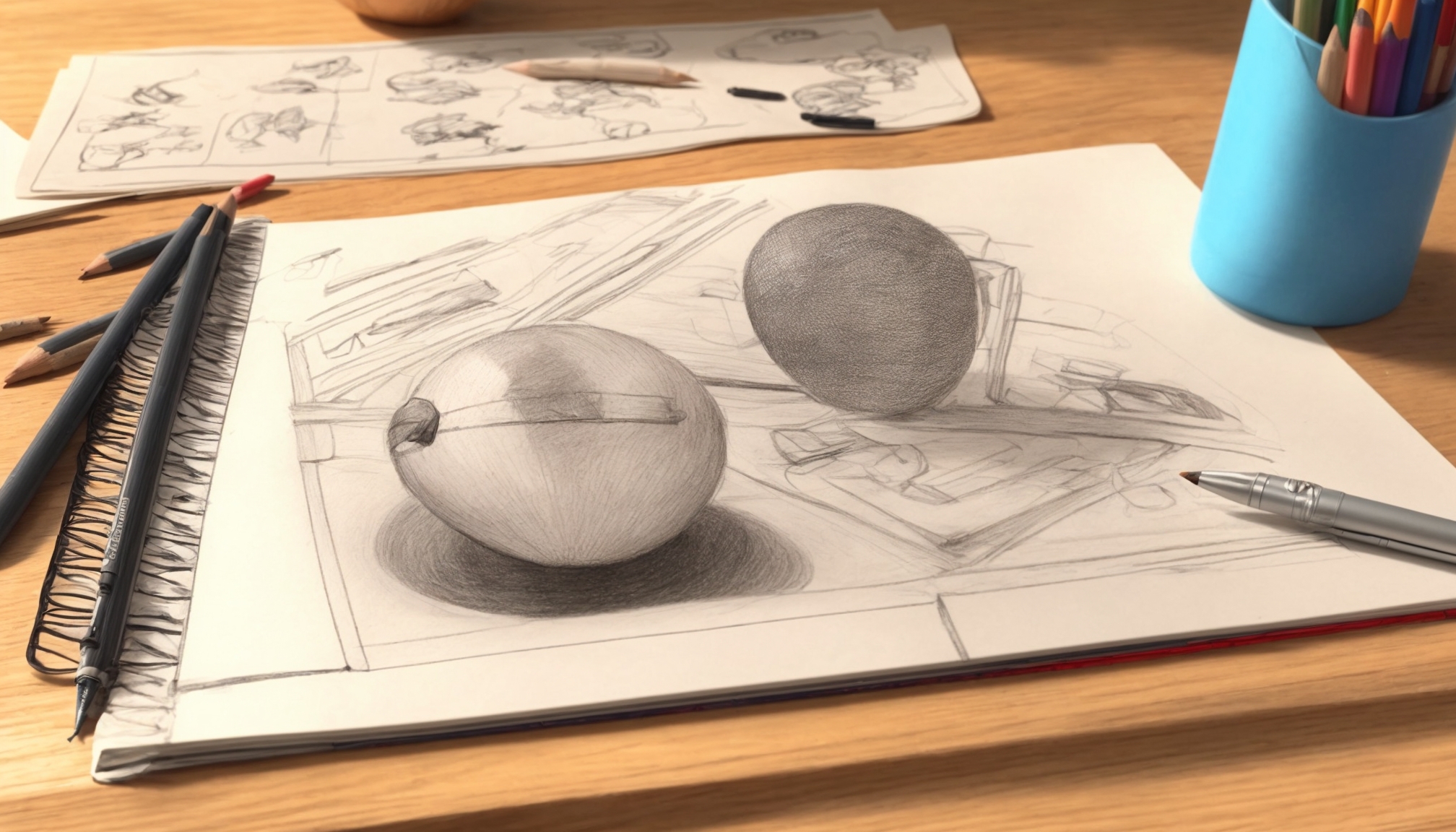
Illustration programs worldwide are evolving rapidly, blending traditional drawing fundamentals with digital tools to meet the demands of the global creative economy.
RobertDraws.com – The global market for art and design education is no longer a quiet backwater. According to a 2023 report by Grand View Research, the global online art education market was valued at USD 2.87 billion and is projected to grow at a compound annual growth rate of 12.4% through 2030, a trajectory that even the most optimistic educators did not predict five years ago.
The convergence of three forces is reshaping who learns to draw, illustrate, and create visual content internationally. First, the explosion of creator-economy platforms has made illustration a viable career path rather than a romantic gamble. Second, AI-generated imagery has paradoxically increased demand for human illustrators who can offer something machines cannot: intentional narrative and cultural nuance. Third, remote learning infrastructure built during the pandemic years created a permanent global classroom that simply did not exist before 2020.
Consider what this means structurally. A student in Lagos, Bogota, or Yogyakarta now has access to the same online masterclass as a student in Paris or New York. The gatekeeping function of geography has been substantially dismantled. According to Skillshare’s 2022 Creator Economy Report, illustration and drawing courses saw a 34% increase in enrollment compared to pre-pandemic baselines, with the largest growth coming from Southeast Asia and Latin America.
The approach to visual art education is far from uniform across borders, and understanding these differences reveals a great deal about where the field is heading. In South Korea and Japan, illustration education remains heavily tied to professional pipeline programs, particularly for animation studios and webtoon platforms. Korean art academies have formalized “webtoon illustration” as a distinct certification track, with institutions like the Korea Manhwa Contents Agency reporting over 8,000 active enrollment slots annually in webtoon-related programs as of 2023.
In contrast, European art education, particularly in the Netherlands and Scandinavia, is leaning hard into conceptual illustration, where students are trained less on technical replication and more on visual problem-solving for editorial, social communication, and activism contexts. This is a meaningful philosophical divergence. The Dutch approach, exemplified by schools like the Royal Academy of Art in The Hague, treats illustration as a critical language rather than a decorative skill.
Meanwhile, in the United States and the United Kingdom, the dominant shift is the migration away from expensive four-year BFA programs toward hybrid micro-credential pathways. Platforms like Domestika and Coursera now offer illustrated course certificates from working professionals that cost under USD 100, compared to the USD 40,000 to USD 80,000 annual tuition at traditional art schools.
Read More: How art schools are reinventing themselves for a digital generation
Here is the analysis that rarely surfaces in mainstream conversations about art education trends: enrollment numbers are being used as the primary success metric when they are arguably the least informative one. When we examined completion rates and post-course portfolio activity across several major online illustration platforms, a striking pattern emerged. Courses with the highest enrollment often had completion rates below 15%. By comparison, structured cohort-based programs, where 20 to 40 students move through material together with peer critique sessions, consistently showed completion rates above 60% and measurably stronger portfolio output.
This matters because the industry is currently over-indexing on access and under-indexing on outcomes. A student who enrolls in ten illustration courses and finishes none of them has not received an education; they have purchased the feeling of learning. The most effective international illustration education programs in 2024 are not the largest ones. They are the ones built around accountability structures: cohort deadlines, mandatory critique submissions, and instructor feedback loops. Schools like NMA (New Masters Academy) and structured programs within Watts Atelier have demonstrated this model outperforms the passive video-on-demand format by nearly every measurable outcome.
If you are an illustrator trying to decide where and how to invest in your education right now, the landscape offers both unprecedented opportunity and genuine noise. Here is a concrete framework built on what the data actually supports. First, treat platform courses as skill acquisition tools, not credential builders. A Domestika course on character design will teach you specific techniques, but it will not build your professional network or give you the critique culture that sharpens real growth. For that, seek out cohort programs, even small ones, where your work is seen and challenged by peers and instructors weekly.
Second, pay attention to the regional specialization happening globally. If your career goal is concept art for games, South Korean and North American programs currently offer the most direct pipeline into studios. If you want editorial illustration work with international clients, European training environments, particularly those emphasizing conceptual and political illustration, will serve you better. Matching your educational investment to the specific professional culture you want to enter is a strategic move that most aspiring illustrators overlook entirely.
Third, and perhaps most importantly, learn to navigate international visual art and illustration education with an eye on portfolio specificity rather than breadth. In a saturated global market, a tightly focused body of work targeting one niche, whether it is children’s book illustration, scientific infographics, or narrative comic art, consistently outperforms a generalist portfolio in attracting clients and program acceptances.
The trajectory is clear: illustration education is globalizing rapidly, becoming more accessible in format while simultaneously more specialized in outcome. The institutions and programs that will matter most in the next five years are those that combine the reach of digital platforms with the rigor of structured critique culture. The era of passive video consumption as a substitute for real artistic development is already showing its limits in retention and outcome data.
For educators, platform builders, and students alike, the most important question is no longer “where can I learn to draw?” but rather “which learning environment will actually make me better?” That distinction, between access and transformation, is where the real conversation about the future of visual art education needs to land. Are you building your illustration practice around the inputs, or the outcomes?
Robert Draws - The global digital art software market hit $10.3 billion in 2023, yet 68% of self-taught beginners abandon…
Robert Draws - A comprehensive 2024 survey by the Association of Independent Colleges of Art and Design indicates that applications…
Robert Draws - The global digital art market has witnessed an unprecedented surge, yet the educational framework for aspiring artists…
Robert Draws - A 2023 survey by the National Art Education Association revealed that 72% of beginners abandon visual arts…
Robert Draws - A recent survey conducted by the Strada Education Network in 2022 reveals that 39% of visual arts…
Robert Draws - The global art market has witnessed a staggering 65 billion USD in sales revenue in 2023, yet…