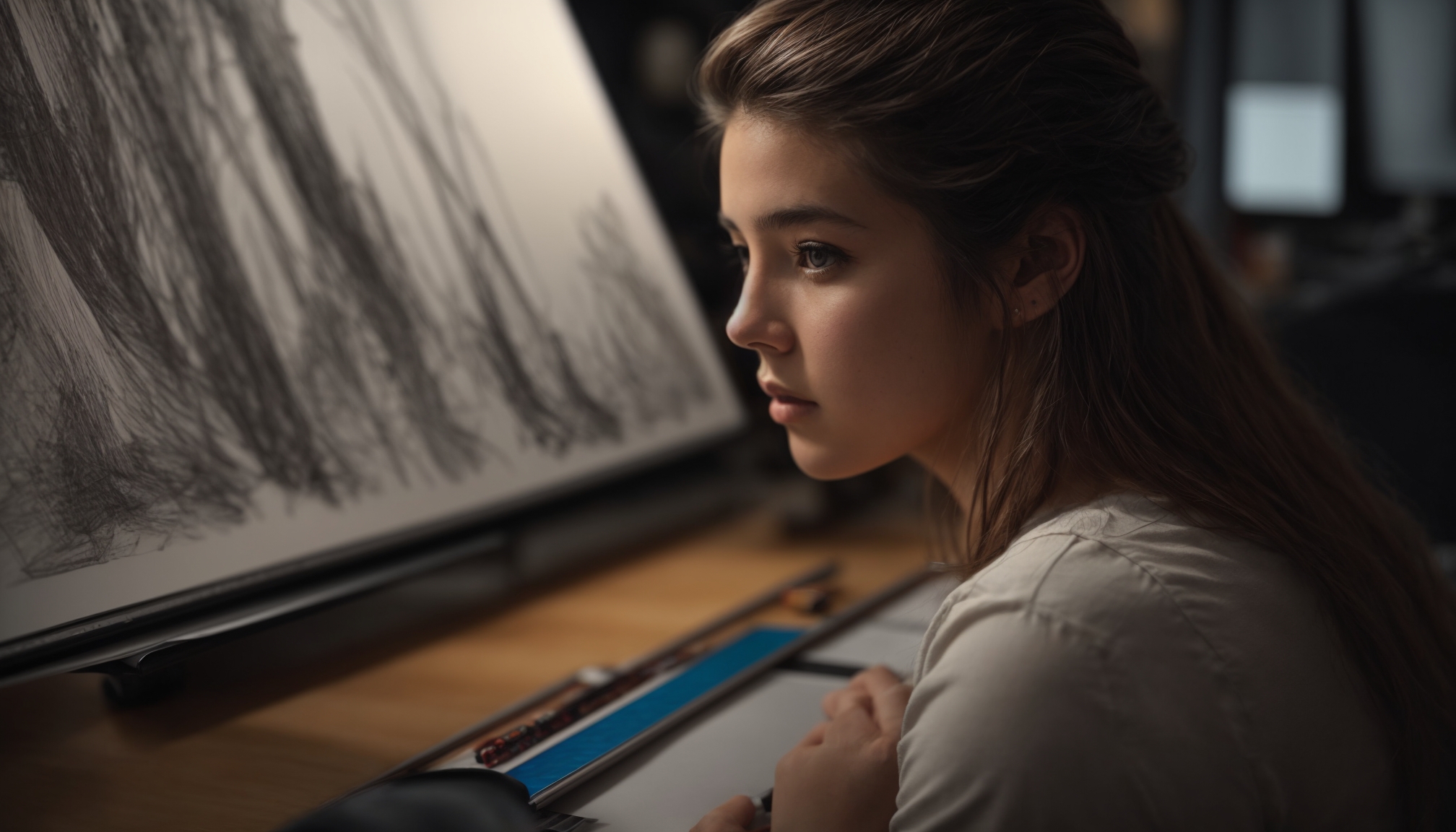
RobertDraws.com – Many digital artists now seek to balance realism and stylization to grow faster and build a recognizable personal style.
Many beginners feel they must choose between realism and stylization. They think realistic art is “serious” and stylized art is “fun.” However, professionals know that the ability to balance realism and stylization is a core skill. It lets you control how believable or exaggerated your work feels.
When artists focus only on copying photos, they may improve accuracy but feel stuck and stiff. On the other hand, if they only draw stylized characters without structure, their work often lacks depth and solidity. Therefore, the decision to balance realism and stylization becomes essential.
Realism is not about making “pretty” copies of references. Instead, it trains your eye to see truthfully. You learn proportion, light, perspective, and subtle shape changes. Because of that, your visual library grows stronger.
When you study realism, you start noticing how light wraps around a cheek, how fabric folds at the elbow, and how fingers overlap in space. As a result, you gain the tools needed to bend reality later with confidence. Every time you practice realism, you prepare to balance realism and stylization more intelligently.
Realism also teaches you discipline. Long studies force you to slow down, compare angles, and measure distances. This habit reduces guesswork when you draw from imagination. Eventually, you no longer copy blindly. You understand what you see and why it looks that way.
If realism builds your foundation, stylization shapes your voice. Stylization is the process of simplifying, exaggerating, and choosing what to emphasize. When you balance realism and stylization, you decide what to keep accurate and what to push for impact.
Stylization lets you communicate mood, personality, and story more clearly. For example, you might enlarge eyes to show innocence, sharpen angles to show intensity, or soften shapes to show kindness. Each choice is a design decision, not an accident.
However, stylization without structure quickly breaks. Hands look random, faces feel inconsistent, and anatomy becomes confusing. That is why artists who skip realism often hit a plateau. They want to design boldly but lack the underlying knowledge needed to balance realism and stylization effectively.
Many artists frame the topic as realism vs stylization, as if they must pick sides. This attitude creates pressure and confusion. In reality, most successful illustrators, animators, and concept artists constantly balance realism and stylization in every project.
When you see a powerful character design, it may look far from realistic. Even so, the proportions, weight, and lighting usually come from solid observation. The artist is not ignoring realism. Instead, they are selectively using it. They know exactly how to balance realism and stylization to match the brief.
On the other hand, a fully realistic portrait often includes subtle stylization. The artist may slightly adjust colors, edges, or shapes to guide the viewer’s eye. Therefore, the “versus” mindset hides how much overlap actually exists between both approaches.
To grow consistently, you can design your routine around both modes. One useful method is pairing each stylized piece with some kind of realistic study. This structure helps you balance realism and stylization without burning out.
For example, you can start your day with a 30-minute portrait study from a photo. Focus on light, proportion, and accurate shape. After that, draw a stylized version of the same face from imagination. Keep the overall structure, but push features to match your taste.
Another method is the “two-pass approach.” First, sketch a realistic version of your subject, paying attention to construction. Then, on a new layer or sheet, redesign it. Simplify lines, exaggerate key features, and test different proportions. Over time, you learn where you personally like to balance realism and stylization.
Read More: Structured online courses that deepen drawing realism and stylization skills
Some artists fear that using references will erase their style. In truth, good reference use supports your uniqueness. When you balance realism and stylization, references become a toolbox, not a cage.
Instead of copying a reference exactly, ask specific questions. How does this lighting setup define form? How does this pose carry weight? How do these clothes fold around the body? Then, apply those answers to your stylized work.
Over time, you collect patterns: how noses look from below, how shoulders rotate, how cast shadows behave. As these patterns accumulate, you can balance realism and stylization on the fly. You no longer rely on a single reference. You combine knowledge from many to create something new.
Your mindset affects how well you balance realism and stylization. If you treat realism as “boring homework,” you will rush and learn little. If you treat stylization as “just vibes,” you will avoid studying problems deeply. Both attitudes slow progress.
Instead, see realism as learning the rules and stylization as playing with them. When you feel stuck with style, return to study mode. When you feel stuck with realism, shift to design mode and ask how you can simplify or exaggerate. This flexible mindset makes it easier to balance realism and stylization in every project.
Another helpful shift is focusing on clarity, not perfection. Ask whether the viewer easily understands your form, gesture, and light. If yes, your current balance realism and stylization choice is working, even if details are not perfect yet.
In the long term, artists who balance realism and stylization tend to adapt better to different jobs and trends. They can work on realistic marketing art, stylized game assets, or expressive comics using the same core skills.
This flexibility protects your career and keeps your practice interesting. You can always switch focus for a season: two months on anatomy realism, then two months on character design. As you cycle between these modes, you naturally balance realism and stylization at a higher level.
Ultimately, you do not need to choose a strict side. You can let your interests guide where you sit on the spectrum. The more you consciously balance realism and stylization, the more your work will feel both solid and uniquely yours.